

FAQ: Our Technology in Austin, TX
At Ranch Road Vision Source in Austin, TX, we combine advanced eye care technology with personalized attention to provide precise vision correction and comprehensive eye health evaluations. Our diagnostic equipment helps us identify eye conditions, refine prescriptions, and customize eyewear to meet each patient's needs. Below are frequently asked questions on our advanced eye care technology.
What advanced eye care technology do you offer in Austin, TX?
At Ranch Road Vision Source, we use Optical Coherence Tomography (OCT), Optomap retinal imaging, I-Care tonometry, Neurolens, digital refraction, corneal topography, and Visioffice lens measurement technology. These tools allow us to provide detailed eye exams, evaluate eye health, and develop personalized vision solutions for our Austin patients.
How does OCT imaging help detect eye diseases?
Optical Coherence Tomography (OCT) captures detailed cross-sectional images of the retina and its layers. We use OCT to identify and monitor changes associated with glaucoma, macular degeneration, macular edema, and other retinal conditions. This non-invasive imaging provides valuable information that supports early detection and ongoing eye disease management.
What is an Optomap retinal scan, and why is it important?
An Optomap retinal scan captures an ultra-widefield image of the retina, allowing us to examine a larger area of the back of the eye. At Ranch Road Vision Source in Austin, TX, we use this imaging to identify potential retinal abnormalities and monitor eye health. The scan is quick, non-invasive, and often performed without dilation.
How does I-Care tonometry measure eye pressure without an air puff?
I-Care tonometry measures intraocular pressure using a small, lightweight probe that briefly contacts the eye. Unlike traditional air-puff testing, it does not require a burst of air. At our Austin office, this technology allows us to check eye pressure efficiently and comfortably while screening for pressure changes that may be associated with glaucoma.
What is Neurolens, and how does it help evaluate eye misalignment?
Neurolens technology measures small misalignments between the eyes that may contribute to visual discomfort. At our Austin practice, we use this assessment to evaluate patients experiencing eye fatigue, headaches, or discomfort during prolonged visual tasks. When appropriate, we may recommend Neurolens glasses with contoured prism lenses to support more comfortable binocular vision.
How does digital refraction improve prescription accuracy?
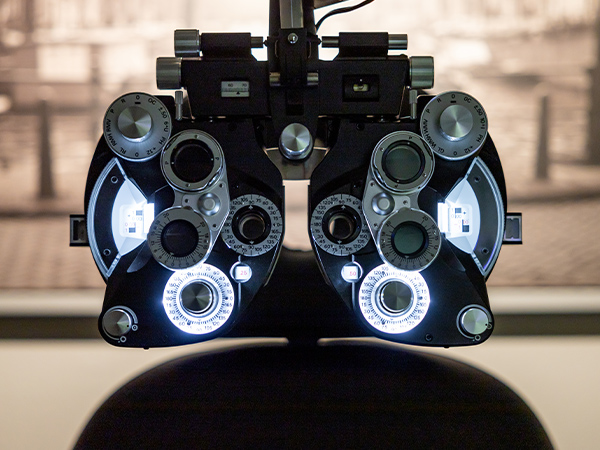
Our Marco TRS 5100 digital refractor uses electronic controls to streamline the prescription testing process. Working with the M&S Automatic Chart Projector, it allows us to make precise lens adjustments and efficiently compare prescription options. This technology helps our Austin optometrists refine glasses prescriptions according to each patient's visual needs.
What is corneal topography used for during an eye exam?
Corneal topography creates a detailed three-dimensional map of the cornea's shape and curvature. At Ranch Road Vision Source in Austin, TX, we use this technology to identify irregular astigmatism, corneal abnormalities, and changes in the eye's surface. These measurements also provide important information for specialty contact lens fittings and refractive surgery evaluations.
How does Visioffice technology help customize prescription glasses?
Visioffice uses advanced digital measurements to support personalized eyeglass lens design and positioning. At our Austin optical practice, this technology helps us account for individual facial measurements, eye positioning, and frame fit. These details allow us to customize prescription lenses for each patient's vision needs and selected eyewear.
What is the difference between OCT and Optomap retinal imaging?
OCT and Optomap provide different views of the retina. OCT captures detailed images of retinal layers, while Optomap produces an ultra-widefield image showing a broad area of the retina. We use these technologies to examine different aspects of eye health and obtain a more comprehensive understanding of potential retinal concerns.
Can advanced diagnostic technology help detect glaucoma early?
Yes. Our diagnostic equipment helps us identify changes that may indicate glaucoma before noticeable vision loss occurs. We use I-Care tonometry to measure eye pressure and OCT imaging to evaluate important retinal and optic nerve structures. We combine these findings with comprehensive eye examinations to determine whether additional glaucoma testing or monitoring is necessary.
How does corneal mapping help with specialty contact lens fittings?
Corneal mapping provides detailed measurements of the eye's surface, which are especially valuable when fitting specialty contact lenses. At Ranch Road Vision Source in Austin, TX, we use corneal topography to assess irregular corneas, astigmatism, and other factors that influence lens selection. These measurements help us develop personalized contact lens fitting recommendations.
Can your eye care technology help determine if I am a candidate for LASIK?
Yes. Our corneal topographer provides important measurements that help us evaluate the cornea's shape and identify irregularities relevant to LASIK candidacy. Our eye doctors in Austin use these findings alongside your prescription, eye health, and other clinical factors to assess whether a refractive surgery consultation is appropriate. Additional testing is necessary before confirming eligibility.
Do retinal imaging tests eliminate the need for eye dilation?
Not always. Optomap retinal imaging allows us to capture detailed, ultra-widefield retinal images without dilation in many cases. However, dilated eye exams remain important when a more thorough examination of specific eye structures is needed. At our Austin office, we determine whether dilation is necessary based on your eye health, symptoms, and examination findings.
Is advanced eye care technology comfortable for children and adults?
Our diagnostic equipment is designed to make many aspects of eye testing quick and comfortable for patients of different ages. Optomap imaging, OCT scans, and digital refraction are non-invasive, while I-Care tonometry avoids the traditional air puff. At Ranch Road Vision Source in Austin, TX, we select appropriate testing based on each patient's age, comfort, and clinical needs.
Why choose Ranch Road Vision Source for advanced eye care in Austin, TX?
At Ranch Road Vision Source, we combine comprehensive eye exams with advanced diagnostic equipment and individualized care. From OCT and Optomap retinal imaging to Neurolens assessments, corneal topography, and Visioffice lens measurements, our technology supports detailed evaluations and personalized vision correction. Our team focuses on accurate assessments, clear recommendations, and long-term eye health.
To learn more about our advanced eye care technology or schedule a comprehensive eye exam, contact Ranch Road Vision Source in Austin, TX, at (512) 893-2020. We look forward to helping you maintain healthy eyes and clear, comfortable vision.
Helpful Articles
All Eye Care Services
Find personalized eye care excellence with our comprehensive services. From eye exams to advanced diagnostics, trust us for all your vision needs.
Keep In Touch
For non-urgent questions or to learn more about our services, contact us today!
© 2026 Ranch Road Vision Source. All rights Reserved - Accessibility Statement - Privacy Policy - Sitemap
Managed and Designed by 